

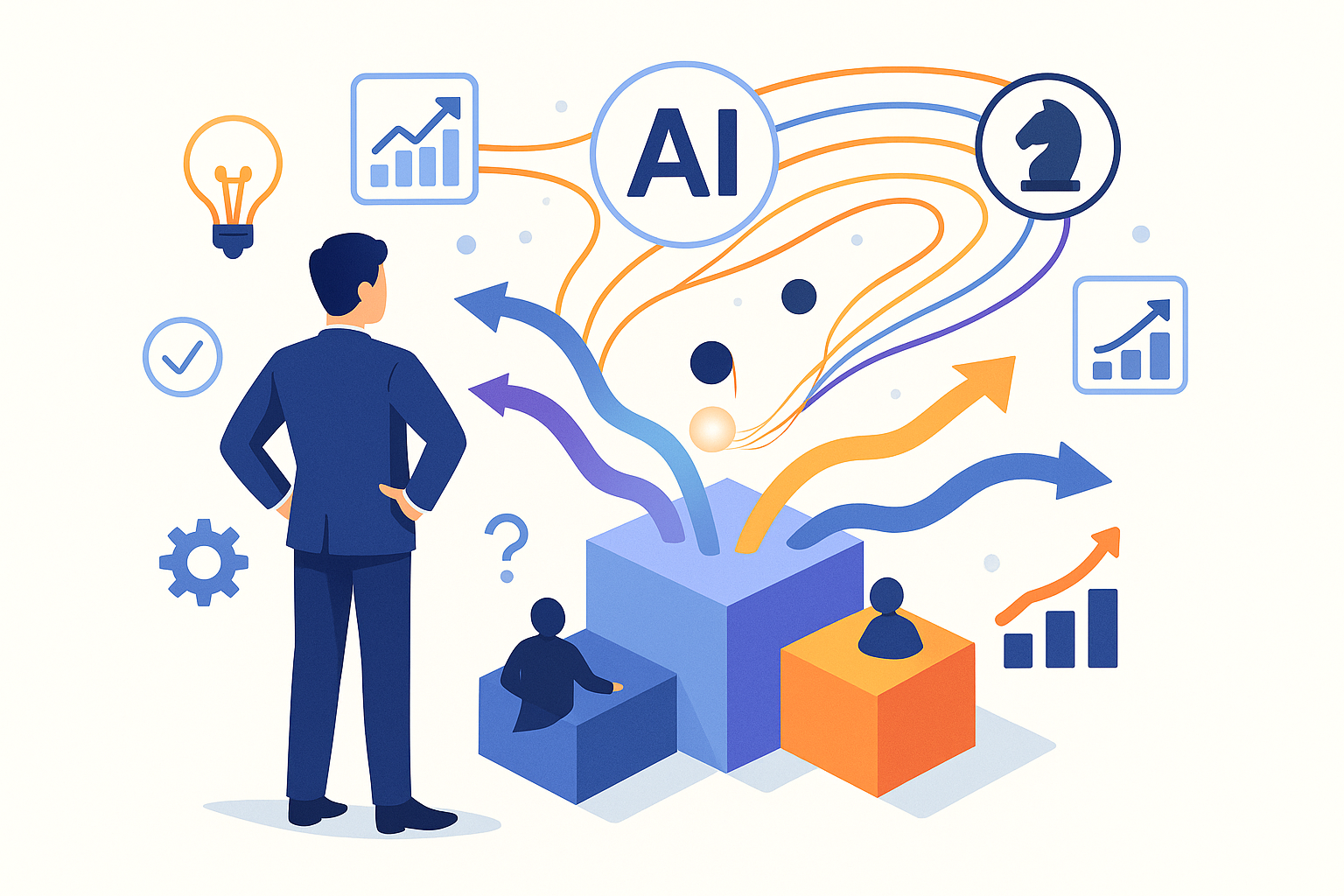
When was the last time you hired someone for a role that didn’t even fully exist two years ago?
Choosing an AI analyst today feels a bit like buying a first-generation smartphone: you don’t really know what you need until you start using it. You can read specs, watch reviews, compare brands—but ultimately, the real value emerges through trial, error, iteration, and adaptation.
The truth?, You don’t need a unicorn. You need alignment.
And the following five principles (plus two more) will help you choose an AI analyst who can navigate complexity, build clarity, and drive results.

1. If you think an Ai Analyst = Data Analyst, you’ve already lost!
A common mistake: hiring “an analyst” assuming it’s a junior, spreadsheet-driven role.
AI analysis requires seniority, business acumen, and cross-functional intuition.
Sure, they might have started as data analysts. But the role is much broader:
- They must understand how the business actually works
- They must know what decision-makers care about
- They must recognize how AI models influence revenue, costs, and customer experience
Think of it like hiring a pilot: yes, they need to know how to fly, but more importantly, they must know where to go, how to navigate unknown weather, and what to do when the system behaves unpredictably.
According to a 2024 McKinsey report, companies that combine analytics talent with strategic decision-making see 30–60% faster impact compared to those who hire purely technical profiles.
AI analysts ≠ data interns.
AI analysts are strategic operators.
AI analysis requires seniority, business acumen, and cross-functional intuition.
2. Hard skills are as important as soft skills (maybe even more)
Many executives still imagine AI analysts as “the Python person” or “the R expert”—someone who speaks fluent NumPy and dreams in SQL.
Sure, the technical stack matters. Python and R are non-negotiable languages in the AI ecosystem.
But here’s the truth: AI analysis is a people job disguised as a tech job.
An AI analyst must:
- Communicate complex findings simply
- Motivate cross-functional teams
- Guide expectations realistically
- Translate model results into strategic decisions
- Diagnose risks and ethical implications
A brilliant technical mind who can’t communicate results will stall your project. A strong communicator with weak technical skills will mislead you.
You need both.
3. Know your inputs and your expected outputs (even if imperfect)
Most AI failures are not technical—they are conceptual.
Companies jump into AI because it’s “the new thing,” just like social media was a decade ago: “We need a model!” becomes the new “We need a Facebook page!”
But the rule of real AI work is simple: “garbage in, garbage out.”
If your data is incomplete, inconsistent, non-standardized, or poorly labeled, no AI analyst—senior or magical—will fix the outcome. And if your goal is unclear, even good data won’t save you.
Ask yourself, before hiring:
- What problem are we trying to solve?
- What business metric should improve?
- What data do we have, and in what condition?
- What does “success” look like—even if in rough terms?
AI models optimize for what you tell them. If you don’t know what you want, they can’t help you get it.
4. Look for talent that experiments, not talent that protects a resume
AI evolves daily. New frameworks emerge, APIs change, models behave differently from one version to the next.
Your AI analyst can’t be someone who says: “I need a full course before I touch this.” or “I’ve always done it this way.”
You need someone who loves experimentation, someone comfortable with ambiguity, someone who understands that most innovation begins with tests that fail.
Hiring someone who is afraid to try is like hiring a chef who refuses to taste the food.
5. Choose someone who understands risk, ethics, and guardrails
AI is not just about intelligence—it’s about responsibility.
Your analyst must be able to:
- Detect bias in datasets
- Understand privacy implications
- Evaluate risks in model outputs
- Challenge unrealistic expectations
- Recommend when not to use AI
In a 2023 Stanford AI Index study, 51% of executives reported at least one case of AI misuse or unintended consequence inside their organizations.
A good AI analyst doesn’t just accelerate innovation—they prevent disasters.
6. (Bonus) Hire someone who builds value, not someone who builds slides
Great AI analysts don’t hide behind buzzwords or dashboards.
They drive:
- revenue
- efficiency
- cost optimization
- new opportunities
- measurable impact
If the outcome is only “pretty charts” and “nice visualizations,” you didn’t hire an AI analyst—you hired a PowerPoint designer.
You’re Not Choosing a Profile—You’re Choosing a Learning Partner
Hiring an AI analyst shouldn’t feel like checking boxes on a job description.
The technology is too new, too dynamic, too unpredictable for that.
Instead, think of this role as choosing the person—or the intelligent system—that will help your organization navigate a period of reinvention.
The best AI analyst is not the one who knows everything. It’s the one who helps you discover what truly matters, even when the path is not yet defined.
If you choose someone who can think, learn, communicate, experiment, and connect business value with data…you won’t just keep up with the AI revolution—you’ll lead it.



7 Comments
注册Binance
I don’t think the title of your article matches the content lol. Just kidding, mainly because I had some doubts after reading the article.
Тркелу
Your point of view caught my eye and was very interesting. Thanks. I have a question for you. https://accounts.binance.info/uk-UA/register?ref=XZNNWTW7
binance open account
Thank you for your sharing. I am worried that I lack creative ideas. It is your article that makes me full of hope. Thank you. But, I have a question, can you help me?
binance推薦
Can you be more specific about the content of your article? After reading it, I still have some doubts. Hope you can help me.
Binance Signup Bonus
Thanks for sharing. I read many of your blog posts, cool, your blog is very good.
registro de Binance US
Your point of view caught my eye and was very interesting. Thanks. I have a question for you.
binance registracn'y bonus
Can you be more specific about the content of your article? After reading it, I still have some doubts. Hope you can help me.